AI isn’t replacing waiters; it’s empowering them. Learn how smart assistance answers repetitive guest questions, enhances service quality, and frees up staff to focus on human hospitality with Chocochip.ai’s training and automation tools.


Picture a Saturday dinner rush. Every table is full, the kitchen is backed up, and your most experienced server is standing at table 7 explaining for the fourth time tonight: that yes, the risotto can be made without parmesan, but no, the pasta sauce does contain gluten.
Meanwhile, table 12 has been waiting three minutes for someone to take their order.
This is the repetition problem. And it costs your servers more energy, more time, and more mental bandwidth than most restaurant owners realise.
AI doesn’t solve every challenge in a busy restaurant. But it is remarkably good at one specific thing: absorbing the tasks that repeat themselves 30, 40, 50 times a shift — so your servers can be present for the work that actually requires a human.
Here is a practical breakdown of exactly how AI reduces repetitive tasks for restaurant servers, shift by shift.
The Repetition Tax on Your Servers
Before getting into solutions, it helps to quantify what is actually happening on your floor.
A typical server in a mid-volume US restaurant handles between 30 and 50 near-identical customer interactions per shift. These are not complex service moments.
They are information requests. Allergen questions. Ingredient clarifications. “How spicy is this?” and “Can I swap the side?” and “Is the kitchen still serving the special?”
Each one takes 30 seconds to two minutes. Each one pulls your server away from a table, interrupts their flow, and adds to an accumulating cognitive load that gets heavier as the night goes on.
The staffing pressure is real — according to the National Restaurant Association’s 2025 State of the Industry report, 77% of operators say recruiting and retaining employees remains a top challenge. That makes protecting the energy and attention of the servers you already have more important than ever
The result is not just slower service. It is servers who are too mentally drained by 8pm to deliver the warm, attentive hospitality that earns you five-star reviews because they spent the first half of their shift functioning as a human FAQ page.
AI targets this problem directly. Not by replacing servers, but by handling the parts of the job that do not require judgment, empathy, or a human presence.
The 5 Repetitive Tasks AI Handles Best
1. Allergen and Ingredient Questions
This is the highest-volume repetitive task in most restaurants, and also the highest-stakes one. A server who gives an uncertain or incorrect allergen answer is not just a service problem — it is a liability.
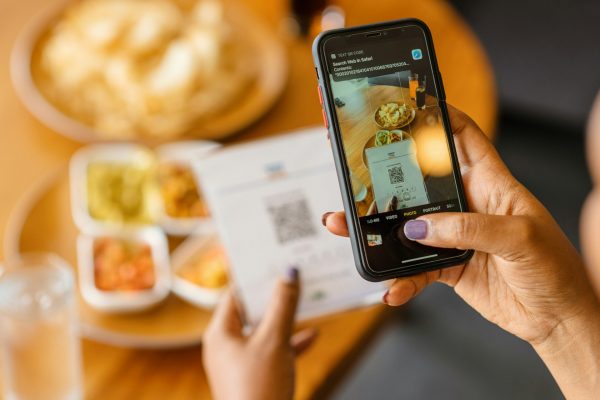
AI menu assistants, like the one built into Chocochip’s QR menu system, pull directly from your real-time menu data. When a guest scans the QR code and asks whether a dish contains nuts or whether something is gluten-free, they get an instant, accurate answer — without flagging down a server at all.
For the questions that still come verbally, servers can check the AI tool on their device in seconds rather than walking to the kitchen or hunting for the allergen binder.
The shift: servers stop being the first line of allergen lookup and start being the confirmation layer when it genuinely matters.
2. Modification and Substitution Requests
“Can I get that without the sauce?” “Is it possible to swap the fries for a salad?” “Can I have the dressing on the side?”
These questions are not hard. But they are constant, and handling them confidently requires your server to either know every modification your kitchen accepts — or go ask. AI handles this lookup instantly, giving servers the answer they need without breaking stride.
3. Recommendations and Pairings
“What would you recommend?” is a question most servers love when they have time for it — and dread when they have four tables waiting.
AI can take the first pass here. A guest browsing the QR menu can ask for popular dishes, the chef’s recommendations, or what pairs well with a particular wine. The AI surfaces data-backed answers drawn from order history and menu relationships. When the server does engage, they are building on an already-informed guest rather than starting from scratch.
For a deeper look at how AI handles the full range of menu questions guests ask, see How AI Answers the 1,000 Questions Your Menu Creates.
4. Order Taking During Peak Hours
During a rush, the bottleneck is often not the kitchen — it is the gap between a guest being ready to order and a server being available to take the order.
AI-assisted or self-serve ordering through a QR menu closes that gap. Guests order when they are ready. Orders go directly to the POS. Servers spend less time as transcription machines and more time managing the floor, checking on tables, and handling the moments that require a real person.
5. Reservation and Wait Time Queries
- “How long is the wait?”
- “Can I book a table for next Friday?”
- “Is the private dining room available?”
These are pure information requests that consume server time every single day. AI tools integrated with your reservations system can handle all of these automatically online, on your website, and through your QR system without a single staff member involved.
Ready to serve smarter menus?
Get in touch
What Servers Can Do With the Time Back
This is the part that matters most to your business.
When servers are not spending 40% of their shift on repetitive information retrieval, they become genuinely better at the job. Not because they are smarter or more experienced, but because they have the mental space to use what they already know.
In practice this looks like:
- Noticing the table that needs attention before they have to wave someone down
- Personalising the interaction: remembering a regular, picking up on a mood, adjusting the pace for a couple clearly on a date
- Upselling with confidence rather than rushing through the suggestion because three other tables are waiting
- Handling complaints with full attention rather than half a mind on the queue of questions building up behind them
This is not a soft benefit. Restaurants where servers can operate this way consistently see better reviews, higher check averages, and stronger repeat visit rates.
If you want to understand the broader operational impact on your team and guests, this breakdown of how Chocochip works as a resaturant agent is worth reading alongside this article.
A Realistic Picture: What AI Does Not Replace
It is worth being direct about this.
AI does not replace the human judgment that good service requires. It cannot read body language. It cannot tell that the guest at table 4 is celebrating something and could use an extra moment of warmth. It cannot de-escalate a genuinely upset customer the way an experienced server can.
The future of restaurant service is not servers versus technology. It is servers whose energy and attention are protected by technology so that when a human moment is needed, they have something left to give.
The restaurants getting this right are not using AI to cut headcount. They are using AI to make the headcount they have meaningfully more effective.
Getting Started: What to Look For in a Restaurant AI Tool
If you are evaluating AI tools for your floor staff, these are the capabilities that actually move the needle on repetitive task reduction:
- Real-time menu integration — the AI must pull from live menu data, not a static document. Outdated answers create more problems than no AI at all.
- Allergen accuracy — look for systems that flag allergen information clearly and update automatically when menu items change.
- POS integration — for order-taking automation to work, it needs to connect directly with your existing point-of-sale system.
- Staff-facing and guest-facing modes — the best tools work both ways: guests can self-serve, and servers can query the same system from their device.
Chocochip’s smart QR menu is built around exactly these capabilities. It turns your menu into a live, interactive system that handles the repetitive layer of service automatically — and gives your servers back the time and attention that separate a good restaurant from a great one.
FAQ
Will AI make some of my servers redundant?
The evidence from restaurants currently using AI tools does not support this. What typically happens is that the same number of servers can handle more covers — which means more revenue without adding to your labour bill.
How long does it take to set up an AI menu system?
With tools like Chocochip, setup is measured in hours, not weeks. Your menu data is uploaded once, the system learns it, and you are live. Updates to the menu sync automatically after that.
What if guests do not want to use a QR menu?
Servers can still take orders the traditional way. AI tools work alongside your existing service model, not instead of it. Guests who prefer a paper menu or verbal interaction still get that.
How do servers feel about working alongside AI tools?
Anecdotally and in reported data, servers tend to respond positively once they experience a shift where they are not fielding the same allergen question for the eighth time. The tools reduce a specific kind of fatigue that is rarely talked about but very real.
Chocochip.ai helps US restaurants reduce the repetitive load on their servers with a smart QR menu that handles guest questions, allergen lookups, and order capture in real time. Get started here →