Not sure what a restaurant AI agent actually is, or whether it’s just tech jargon? This guide explains exactly what it does, how it differs from a basic chatbot, and whether it makes sense for your restaurant. No technical background needed.

You have probably seen the phrase “AI agent” popping up in articles about restaurant technology. Maybe a vendor mentioned it in a sales call, or a fellow owner said they were testing one. But if you are not sure what the term actually means, or whether it is just another piece of tech jargon, then this guide is for you.
No technical background required. No hype. Just a plain-English explanation of what a restaurant AI agent is, what it does on a day-to-day basis, and how to figure out whether it makes sense for your restaurant.
What Is a Restaurant AI Agent? (And Why Your Business Needs One)
A restaurant AI agent is software that can independently handle specific tasks in your restaurant like answering guest questions, taking orders, managing reservations, or handling phone calls without a human being involved in each interaction.
The word “agent” is important here. It means the system can take action, not just provide information. It does not just tell a guest what is on the menu, it can take their order, send it to your kitchen, and confirm the booking, all on its own.
In restaurants, AI agents serve as virtual assistants that handle everything from taking orders to managing reservations, making decisions, and creating seamless experiences for both customers and staff. (Source: AppInventiv)
The simplest way to think about it: a restaurant AI agent is a member of your team that works 24 hours a day, never calls in sick, handles the same question for the 50th time with the same patience as the first, and gets faster and more accurate over time.
How Is an AI Agent Different from a Chatbot?
This is the most common question, and the distinction genuinely matters.
A chatbot follows a script. It has a fixed set of questions it can answer. Ask it something outside that script and it either gives you a wrong answer or tells you it does not understand. Most of the “chat” buttons you see on restaurant websites are basic chatbots.
An AI agent understands what you are trying to do, even if you phrase it in an unexpected way. It can handle multi-part questions, context, and follow-ups. It can take action and not just answer.
For example:
A chatbot can answer: “What time do you close?”
An AI agent can handle: “I want to book a table for 6 on Friday evening, two of us are gluten-free, is your set menu suitable?” and then actually make the booking, flag the dietary requirements, and send a confirmation.
How Does It Actually Work? (The Simple Version)
You do not need to understand the technology to use it — but a basic mental model helps.
A restaurant AI agent has three core capabilities working together:
1. It understands natural language You can ask it a question in plain English the way you would ask a person. It understands intent, not just keywords. “What’s good for someone who hates spicy food but loves seafood?” gets a useful answer, not an error message.
2. It connects to your menu and systems The agent is trained on your specific menu — your dishes, your prices, your allergen information, your daily specials. It pulls from live data, so if you 86 a dish at 7pm, it stops recommending it at 7:01pm. It also integrates with your POS and reservation system so it can take real actions, not just answer questions.
3. It learns over time AI agents use data from every interaction to refine responses, anticipate customer needs, and deliver more human-like service over time. (Source: RestoHost AI) The more it interacts with your guests, the better it gets at understanding what your specific customers want.

Is This Just for Big Chain Restaurants?
No, and this is a misconception worth clearing up directly.
AI is not out of reach for the average restaurateur. Even less-than-tech-savvy restaurant owners can implement AI to streamline operations and improve their guests’ experiences. (Source: PopMenu)
The reality is that smaller, independent restaurants often see the biggest relative impact from AI agents — because they have less staff redundancy to absorb the repetitive work. A 40-seat independent restaurant where the owner is also managing the floor gets more relief from an AI handling phone calls and menu questions than a 200-seat chain with a full front-of-house team.
Setup time with modern platforms is measured in hours, not months. And monthly costs typically start well below what a single part-time hire would cost.
What a Restaurant AI Agent Does Not Do
Being honest about limitations is important here.
An AI agent cannot read the room. It cannot notice that the couple at table 6 just got into an argument, or that the birthday guest at table 12 looks disappointed, or that a first-time visitor needs a little extra warmth to feel welcome.
AI excels at efficiency and consistency, but cannot replicate warmth, intuition, and emotional intelligence. (Source: Zendesk) The human moments that build loyalty like the memorable interaction and the instinctive act of care still belong entirely to your staff.
The job of an AI agent is to protect your team’s time and energy so they have more of both available for those moments. Think of it as removing the noise so the signal – that of genuine human hospitality comes through more clearly. For more on this, see How AI Reduces Repetitive Tasks for Restaurant Servers.
How Do You Know If Your Restaurant Is Ready for One?
You are likely a good candidate if:
- Your phone goes unanswered during busy service periods
- Servers are regularly pulled away from tables to answer the same allergen or ingredient questions
- You have inconsistent upselling — it happens when staff remember to do it, not every time
- You are running a lean team and stretching coverage across too many responsibilities
- You want to offer online or QR ordering but do not have the staff to manage it manually
You are probably not ready yet if:
- You are still running on a paper-based or offline POS with no API connectivity
- Your menu changes daily in ways that are hard to systematise
- Your dining concept relies entirely on a highly personal, off-script service experience (small tasting menu, private dining)
Getting Started: What to Look For
If you are evaluating AI agents for your restaurant, these are the questions that actually matter:
Does it integrate with your existing POS? Toast, Square, and Clover all support AI integrations. If a vendor cannot connect to your current system, move on.
Is the menu data live or static? A system trained on a static upload of your menu is outdated the moment you change a price or remove a dish. Look for real-time sync.
Can it handle both guest-facing and staff-facing interactions? The best tools work both ways — guests can self-serve via QR or phone, and servers can query the same system from their device on the floor.
What does setup actually involve? Reputable platforms get you live in 24–48 hours. If the onboarding process sounds like a six-month IT project, it is not the right fit for an independent or small-group operator.
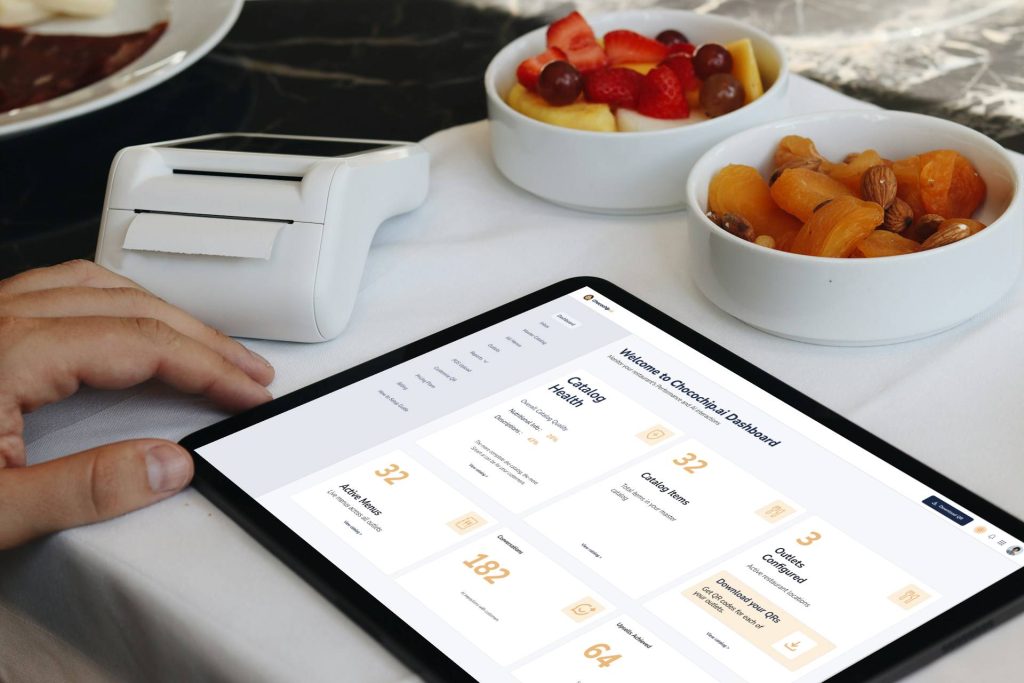
Chocochip’s smart menu is built around exactly this use case: a live, AI-powered menu system that handles the repetitive layer of guest interactions automatically, integrates with your existing setup, and gets your team out from behind the FAQ and back on the floor where they belong.
FAQ
You can’t just plug AI in and hope for the best. Implementation requires a strategic eye, especially for multi-unit operations that need to scale the technology.
Try Chocochip Smart QR Menu
Transform your static PDF or paper menu into an interactive digital experience. Real-time updates, instant recommendations, and staff nudges, all set up faster than brewing a pot of coffee.