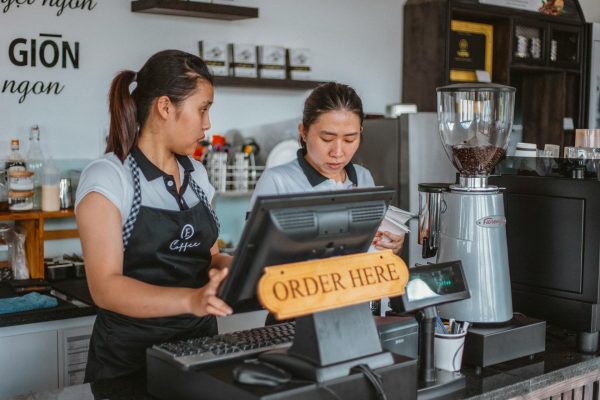
A server guesses wrong about an ingredient. A guest doesn’t come back. Nobody notices. This is not a dramatic story: it’s Tuesday night at most restaurants in America. And it’s exactly the problem a new generation of AI tools is being built to fix.

**Hypothetical restaurant names and scenarios are used throughout as illustrations.**
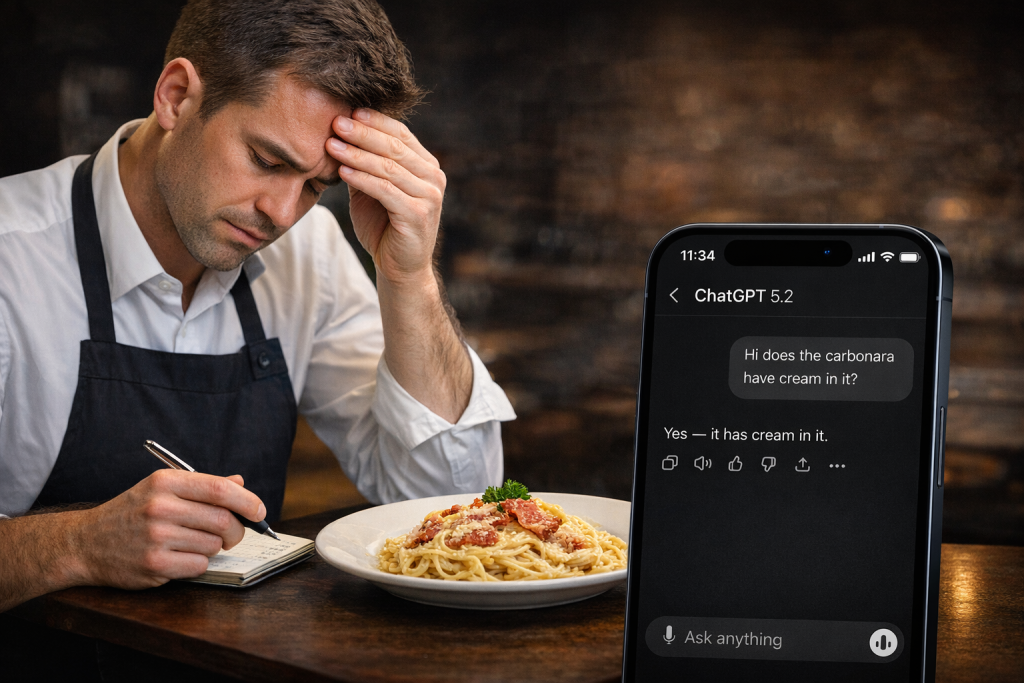
Sometime last year, a server at a neighbourhood Italian spot in Chicago – call it Forma, 45 covers, Wicker Park – got asked by a guest whether the carbonara had cream in it.
She didn’t know. She thought it didn’t. She said it probably didn’t. The guest, who was lactose intolerant, ordered it anyway. It had cream. She didn’t finish it. Didn’t complain loudly. Just didn’t come back.
Nobody logged this. Nobody fixed the training gap. Nobody connected the dots between that moment and the restaurant’s quietly mediocre return-visit rate.
This is not a dramatic story. That’s the point. It’s the kind of thing that happens dozens of times a week in restaurants across the country in the space between what a guest needs to know and what a busy server can reliably tell them. Small moments. Cumulative damage.
AI built specifically for restaurants is designed to close exactly this gap. Not the robots-in-the-kitchen kind that makes headlines. The quieter, more useful kind: the kind that sits in your dining room, knows your menu cold, and makes sure the answer to “does the carbonara have cream?” is never a guess.
Why Restaurants, Specifically
Every industry is getting the AI pitch right now. Restaurants have more reason than most to take it seriously.
The margins are brutal: the average full-service restaurant in the US runs on 3% to 5% net profit. Staff turnover is relentless, around 75% annually in full-service restaurants, which means institutional knowledge walks out the door on a rolling basis. And the guest experience is enormously sensitive to small variables: a confident dish recommendation versus a hesitant one, a dietary question answered correctly versus incorrectly, an upsell that felt natural versus one that felt scripted or missed entirely.
These aren’t technology problems. But technology, applied in the right places, can do something about all three.
The reason AI is particularly suited to restaurants is that restaurant problems repeat. The same guest questions come up every night. The same upsell opportunities get missed in the same predictable moments. The same menu data sits uncollected while owners make decisions from instinct rather than evidence. AI is very good at pattern recognition and very good at showing up consistently. Restaurants have patterns everywhere. They just haven’t had a system to work with them.
The Guest Who Never Got a Good Answer
Consider a couple at a restaurant in Austin: call it The Larder. One is pescatarian. The other is avoiding gluten. They have questions. The server is managing six other tables.
What usually happens: a truncated conversation, some hedging, a safe order that doesn’t fully satisfy either of them, a table that spends less than it would have if someone had just answered their questions well.
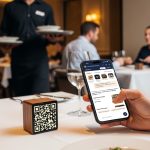
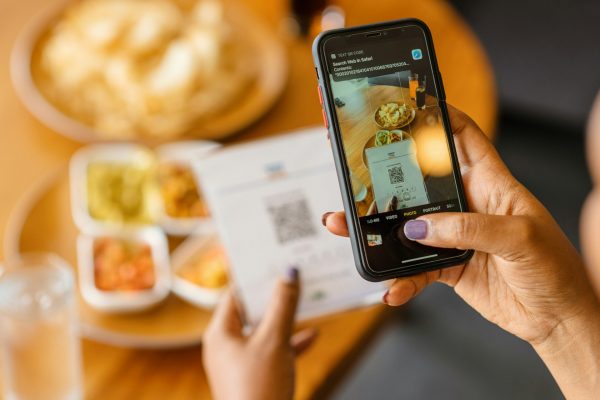
What a guest-facing AI makes possible: a QR code on the table opens a chat. The pescatarian asks what she can eat. The AI, that is trained on The Larder’s actual menu, its actual allergens, its actual ingredients: filters instantly, suggests three dishes, and answers the follow-up about the salmon’s preparation. The server arrives at a table that already knows what it wants and feels good about it.
This is what platforms like Chocochip.ai have built – a chat interface accessed via QR code, trained on a restaurant’s specific menu, available to every guest without adding a single person to payroll. The commercial upside isn’t subtle. Guests who get confident answers order more — more completely, more adventurously. Chocochip reports an average order value increase of up to 35% for restaurants using their guest AI. The mechanism isn’t complicated: uncertainty makes people order safe. Remove the uncertainty, and they order what they actually want.
The Upsell That Never Happened
Here’s an uncomfortable number: servers successfully upsell on fewer than a third of tables, even in restaurants with formal upsell training.
The reason isn’t attitude. It’s attention. A server mid-service is making hundreds of micro-decisions per hour. The moment to suggest the wine pairing with the halibut: a moment that lasts maybe fifteen seconds and would add $18 to the ticket – arrives and passes between one table and the next.
A waiter-facing AI addresses this directly. It sends the server a nudge the moment the opportunity is live. Not a generic reminder – something like: “Table 4 ordered the halibut. The Sancerre by the glass pairs well and hasn’t been mentioned yet.” Specific. Contextual. Gone in two seconds.
Imagine a server named David at Forma. David is good at his job but inconsistent on upsells as are most servers. With live prompting, his wine suggestion conversion goes from one in five tables to three in five. Not because David got better overnight. Because he stopped missing the moment.
Over a month, across a full floor team, that’s a material revenue difference. Chocochip’s waiter assistant does exactly this: real-time nudges, pairing suggestions, and over time, data on which servers are converting and which aren’t. For new hires, the impact is sharper still. A new server with an AI prompting system doesn’t need the entire menu memorised before they can make good recommendations. The system fills the gap while the knowledge builds.
What "ChatGPT for Restaurants" Actually Means
When most people hear AI and restaurants in the same sentence, they picture something futuristic and expensive. Robotic arms plating food. Screens replacing servers. Some sterile fast-food experience that’s technically efficient and completely joyless.
That’s not what this is.
The more useful mental model: imagine giving your restaurant a version of ChatGPT that has memorised your entire menu where every dish, every ingredient, every allergen, every pairing, and can be in two places at once. Talking to your guests at the table. Coaching your servers on the floor. Not after service. During it.
Most owners who’ve tried generic ChatGPT for their restaurant know the experience. You ask it to write a menu description, it produces something serviceable. You ask it what pairs well with your short rib, it gives you a reasonable answer. What it cannot do is tell you whether that short rib is selling tonight, whether the table that just ordered it tends to skip dessert, or whether your server has already mentioned the wine list. It has no idea what’s happening in your dining room. It’s a smart generalist sitting somewhere else entirely.
A restaurant-specific AI is the opposite of that. It’s built from your menu, lives inside your service, and gets more useful the more it learns about how your specific guests order. That’s a meaningfully different thing: and it’s what separates a tool that saves a few hours on copywriting from one that changes how a restaurant actually performs.
What It Doesn’t Do
It doesn’t replace a great floor manager who can read a table from across the room. It doesn’t replicate the warmth of a server who genuinely loves food and makes a guest feel it. The human parts of hospitality i.e. the parts that make someone want to come back are not things a language model substitutes for.
What it removes is the friction that surrounds those human moments. The unanswered dietary question. The missed upsell. The menu data that never becomes a decision.
It’s also not a complex installation. Restaurants using Chocochip upload their menu using a PDF, photos, whatever they have, and are live in minutes. No hardware. No staff retraining. The AI has already been built. The restaurant’s job is to point it at the right problems.
The server at Forma who guessed wrong about the carbonara wasn’t negligent. She was busy, undertrained on that specific detail, and had no system catching what she missed. Those conditions describe most restaurants in America right now.
The ones building something different aren’t running technology experiments. They’re just running a tighter operation than the one next door. The carbonara question gets answered. The upsell lands. The margin-draining dish gets pulled before it does more damage.
Small things. But in a business where the margin between a good year and a hard one is measured in percentage points, small things are everything.
Chocochip.ai offers a free QR menu with AI guest and waiter agents. No hardware, no staff training required. Get started at chocochip.ai.